
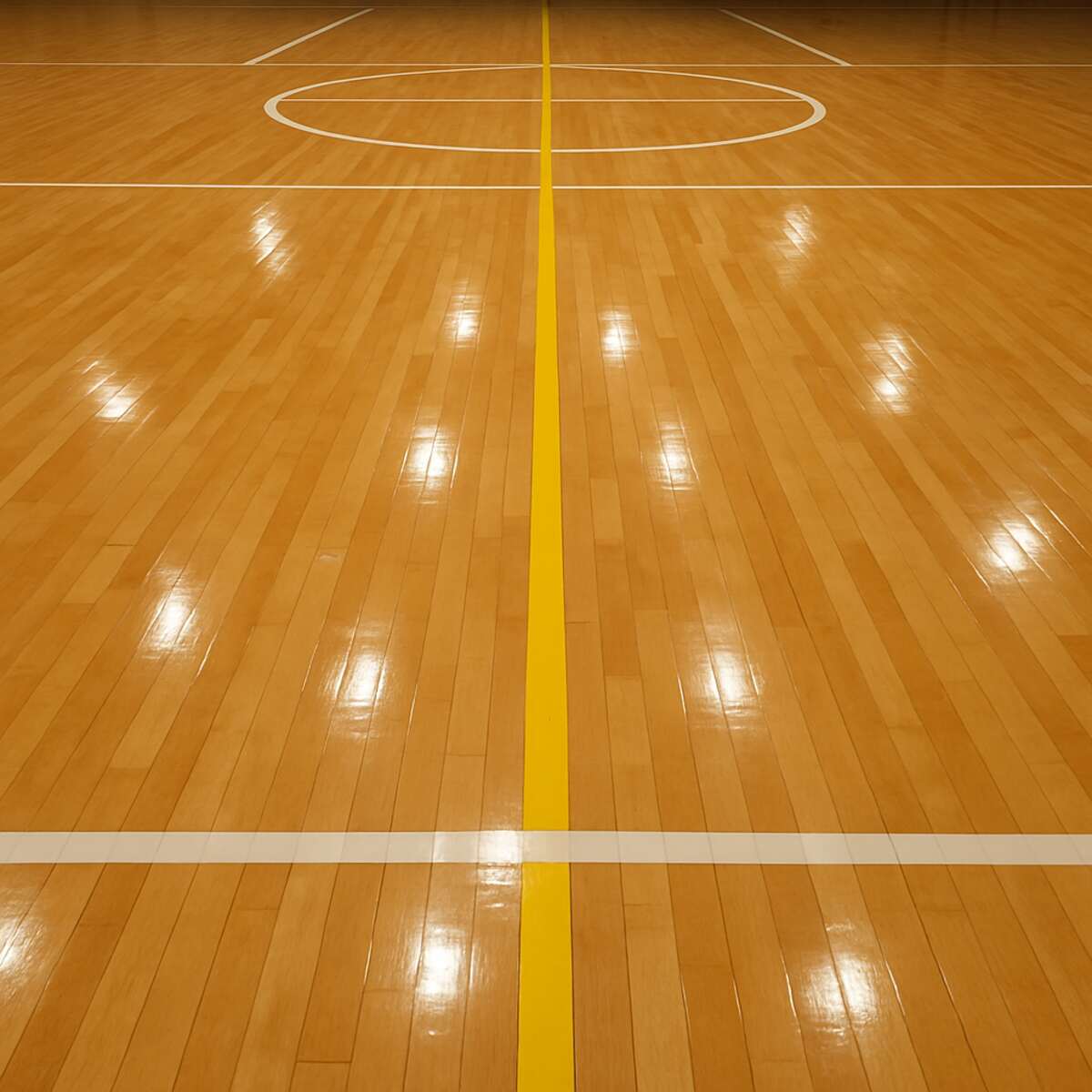

It’s one of the most iconic sounds in sports: the rhythmic thump-thump-thump of a basketball echoing in a gym. That sound, and the perfect bounce that goes with it, doesn’t just come from the ball. It’s a direct result of the floor itself, and that distinct echo is often a clue to its quality. But what makes one gym floor feel springy and alive while another feels dead and hard on your joints? Select the best indoor sports flooring.
The answer is rarely about the polished wood or colorful rubber you see on top. A high-performance sports floor is actually an engineered system made of hidden layers working together. Think of it like the suspension on a car—the visible tires are important, but the real work of absorbing bumps and providing a smooth ride happens in the springs and shocks underneath. The same is true for indoor sports flooring, where a hidden “subfloor” turns a simple surface into a piece of high-tech safety equipment.
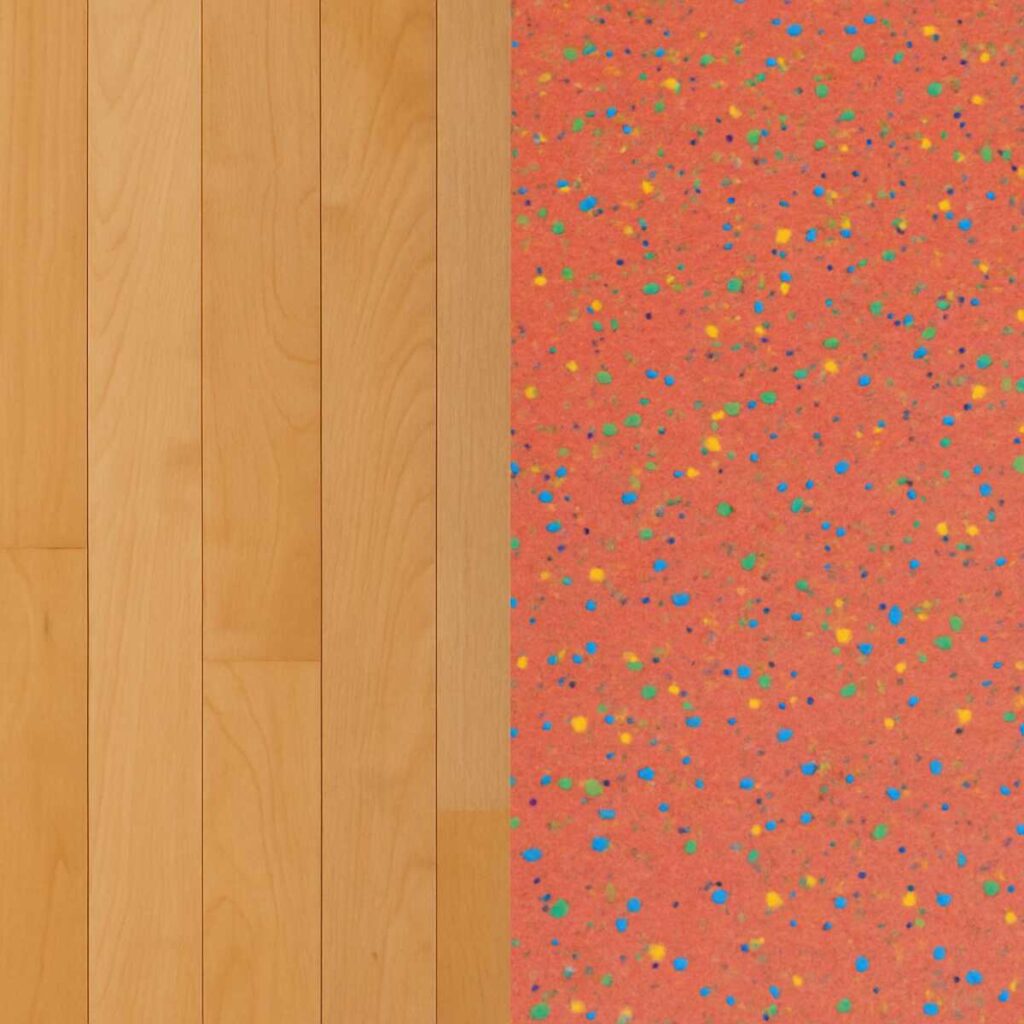
Athletic court surfaces generally fall into two main families. First, there’s the classic hardwood—almost always maple, as seen in NBA arenas—prized for its unparalleled ball bounce and traditional look. Then there are modern synthetic floors. These are the colorful, seamless surfaces you might find in a school’s multi-purpose gym, valued for their durability and versatility for everything from volleyball to assemblies.
The best floor is one designed for the activities it will host and the athletes who will use it. Understanding your options means looking beyond that glossy top layer to the technology working beneath. This guide will break down how these systems provide safety, what makes them perform, and how to tell the difference between a floor that just looks the part and one that truly protects its players.
Hardwood vs. Synthetics: What’s the Difference You Can See and Feel?
Walk into almost any indoor sports facility, and you’ll immediately notice one of two main types of athletic court surfaces: the iconic, gleaming look of classic hardwood or the seamless, often colorful appearance of a modern synthetic floor. While they may seem like simple style choices, these two families of flooring are engineered for very different jobs, fundamentally changing how a game is played on them.
Maple hardwood is the gold standard for sports where ball performance is everything. Think of the perfect, crisp bounce of a basketball on a professional court—that’s the magic of maple. Its dense grain provides an unmatched, uniform rebound that elite athletes rely on. Because it’s specialized for this high level of performance, you’ll almost always find hardwood in dedicated basketball arenas and competition-level gymnasiums.
In contrast, synthetic floors made from materials like vinyl or polyurethane are the versatile workhorses of the sports world. These are the surfaces you find in a high school or community center gym that needs to do it all. Their durable, non-porous nature makes them excellent volleyball court flooring options, while also being tough enough to handle assemblies, dances, and daily foot traffic. They offer a great blend of safety and multi-sport functionality, making them a practical choice for facilities with diverse needs.
The Hidden Engine: What Is a “Sprung Floor” and Why Does It Matter?
Whether it’s hardwood or synthetic, the surface you see is only half the story. The real performance of a high-quality sports floor comes from what’s hidden underneath. Most gyms are built on a rock-hard concrete slab, and installing a sports floor directly over it would be unforgiving on any athlete’s body. To solve this, the best floors are built as a system, incorporating a crucial hidden layer called a subfloor. This engineered under-structure is the secret to creating a surface that is both high-performing and safe.
This is where the term “sprung floor system” comes into play. Think about the difference between jogging on pavement versus on a packed-dirt trail; the trail has a slight “give” that cushions your joints. A sprung floor is designed to replicate that effect indoors. Using components like rubber pads, a sprung subfloor creates a small, often imperceptible space that allows the entire floor to flex slightly upon impact. This clever design is the key to shock absorption in athletic flooring, turning the entire court into a giant shock absorber that disperses the energy from running and jumping.
The term “sprung” can be a little misleading. It doesn’t mean the floor acts like a trampoline to help you jump higher. In fact, its purpose is the opposite. The “spring” is for safety, designed to absorb impact energy that would otherwise jolt an athlete’s ankles, knees, and spine. By cushioning landings and reducing stress on the body, a sprung floor system is one of the most important investments a facility can make in player health and longevity.
How a Smart Floor Protects Athletes from Injury
When an athlete jumps, they have to land. All of that downward force needs to go somewhere, and on a hard surface like concrete, it shoots right back into their joints. A proper sports floor with good shock absorption, however, acts much like a car’s suspension system. The hidden subfloor beneath the surface takes the brunt of that impact, drastically reducing the stress on an athlete’s ankles, knees, and lower back. This makes it the single most important safety feature in any flooring designed to reduce impact on joints.
You might think a floor built for safety would feel mushy or soft, but a well-designed system is much smarter than that. High-quality athletic flooring is engineered to feel firm and stable for walking or standing. The real magic happens during high-impact events, like a volleyball player landing from a spike. In that split second, the floor deforms slightly right at the point of impact, absorbing energy before instantly returning to a firm, stable surface. This dual personality is what makes a great multi-purpose gym floor so versatile and safe.
The benefit of this technology isn’t just about preventing a single, dramatic injury. Think about the thousands of small impacts an athlete endures over a single season. A floor with excellent shock absorption can cut that repetitive force almost in half, protecting players from the gradual wear-and-tear that can lead to chronic pain. Of course, safety from impact is only half the battle; a floor also has to provide a consistent, predictable reaction for the ball itself.
The Science of a Predictable Bounce: What Makes a Great Basketball Court?
A floor designed for safety must also deliver elite performance. While shock absorption is crucial for protecting players, it can’t come at the expense of the game itself. For sports like basketball, the floor has a second, equally important job: giving energy back to the ball. This is often called ball rebound. Think of the difference between dribbling a basketball on plush carpet versus a concrete sidewalk. A “dead” floor that absorbs too much energy kills the ball’s bounce, disrupting the rhythm and pace of play. A great court returns that energy for a crisp, lively response.
However, the real secret to a high-performance court isn’t just how high the ball bounces, but how consistently it bounces. An athlete must be able to trust that a dribble near the sideline will have the exact same height and speed as a dribble at the top of the key. Cheaper floors or those in poor condition can develop “dead spots,” where the bounce is noticeably weaker. This unpredictability can throw off a player’s timing and undermine the integrity of the game.
When it comes to providing this uniform, energetic bounce, solid maple hardwood is the undisputed champion. As the best basketball court surface material, its dense, tight-grained structure offers a perfectly consistent surface that meets professional sports floor ball bounce standards. While a vinyl sports court offers versatility, the natural properties of maple hardwood deliver the predictable performance that top-level basketball demands, making it the gold standard in arenas worldwide.
A Closer Look at the Champion: Maple Hardwood Floors
The reason for maple’s dominance isn’t arbitrary. The specific type of wood used, Northern Hard Maple, grows slowly in the cold climates of the northern U.S. and Canada, creating an incredibly dense and tight-grained wood. This unique structure makes it extraordinarily strong and resistant to splintering, which is exactly what you want when athletes are constantly running, jumping, and diving on its surface.
This density is the secret behind maple’s elite performance. As the best basketball court surface material, it provides that satisfying, high-energy ball rebound that players and fans expect. Its durability also means that with proper care, a maple floor can last for decades, often outliving many other parts of a building. When you see a gleaming court in a professional arena, you’re not just looking at wood; you’re looking at a hand-selected material perfected by nature for high-impact sport.
Of course, every champion has a weakness. For maple, it’s moisture. The same natural fibers that give it strength will also absorb water like a sponge, causing the wood to swell, warp, and buckle. This makes proper gym floor maintenance and cleaning absolutely critical—no wet mops allowed! When deciding between maple hardwood vs. a vinyl sports court, this is often the key difference.
- Pro: Unmatched ball bounce and performance.
- Pro: Classic, professional aesthetic.
- Con: Significant upfront investment.
- Con: Highly sensitive to water and improper cleaning.
The Versatile Workhorse: Vinyl and Polyurethane Synthetic Floors
While maple is the king of the dedicated court, its weakness to water and high cost make it impractical for many community spaces. This is where synthetic floors shine. Often seen in school gymnasiums and recreation centers, these surfaces are designed for versatility and toughness. The most common type, a vinyl sports court, comes in large, cushioned rolls that are laid down to create a durable, water-resistant surface. Spills can be wiped up without a second thought, making them an excellent choice for anyone wondering how to choose a multi-purpose gym floor that can handle everything from volleyball practice to a community event.
Synthetic floors generally come in two popular forms: vinyl rolls or a special type of polyurethane seamless sports floor. Unlike vinyl, which has seams between the rolls, polyurethane floors are poured in liquid form and spread across the entire surface to create one solid, unbroken sheet. Think of it like frosting a giant cake—there are no cracks or gaps where dirt and bacteria can hide. This makes them exceptionally hygienic and easy to clean, while also offering a perfectly uniform surface for play. Their vibrant color possibilities and ability to embed crisp game lines and logos directly into the floor are a huge bonus.
This incredible durability and ease of care make synthetics the undisputed champion of the multi-purpose room. They can withstand the scuff of street shoes, the setup of tables and chairs for an assembly, and then be ready for a basketball game the next day. Their cushioned layers still provide excellent shock absorption to protect athletes’ joints, making them a safe and practical all-around solution. But for areas with extreme, concentrated impact—like where heavy weights are constantly dropped—an even tougher material is needed.
Built for Power: Why Weight Rooms Need Rubber Flooring
When you walk into a dedicated weight room or the free-weight area of a commercial gym, you’re almost certainly standing on rubber flooring. Rubber flooring for weight rooms is less about athletic performance and all about brute-force protection. Its primary job is to absorb the massive impact of a dropped barbell, protecting not only the expensive equipment but also the concrete slab underneath from cracking. This makes it an incredibly popular home gym floor solution, especially when installing a sports floor over concrete in a basement or garage.
The secret to rubber’s success is its incredible density. Unlike a wood or vinyl floor that could dent or puncture under a dropped dumbbell, thick rubber tiles or rolls simply absorb the blow and show little to no damage. This material acts like a giant shield for the subfloor, deadening both sound and vibration from heavy impacts. It effectively takes all the energy from a falling weight and disperses it safely, preventing structural damage that could otherwise occur over time.
The very properties that make rubber perfect for weightlifting make it terrible for court sports. Its high-friction surface, which prevents lifters from slipping, is ill-suited for the quick pivots in basketball or volleyball. More importantly, rubber is designed to absorb energy, not return it. A basketball dropped on a rubber floor gives a dull, lifeless thud instead of a crisp, predictable bounce. This fundamental trade-off presents a real challenge for facilities that need one floor to do it all.
The Multi-Purpose Gym Challenge: Finding One Floor for Every Activity
The fundamental trade-off between performance and protection creates a classic dilemma for facilities like school gyms and community centers. The floor needs to be bouncy enough for a competitive basketball game on Friday night but durable enough to handle tables and chairs for a fundraiser on Saturday. A professional-grade maple hardwood court is perfect for the game, but it can be easily damaged by non-athletic use.
The answer starts with one simple question: What will the floor be used for most of the time? Prioritizing the primary activities is the key to making the right compromise. If the space is a dedicated sports venue first and foremost, with only occasional events, then a performance-focused surface makes sense. However, if the gym’s schedule is an even split between sports, assemblies, and community gatherings, then durability and ease of maintenance move higher up the list. This simple exercise provides a clear path for how to choose a multi-purpose gym floor.
For most facilities facing this challenge, modern synthetic surfaces have become the go-to solution. Materials like performance vinyl and polyurethane offer a “best of both worlds” balance that classic hardwood or tough rubber can’t match. When comparing a maple hardwood vs vinyl sports court, the vinyl provides very good shock absorption and a consistent ball bounce—great for basketball and common for volleyball court flooring options—while also being resilient enough to resist scuffs from street shoes and equipment.
Keeping Your Floor Safe and Fast: Simple Maintenance That Matters
A slippery gym floor can feel like a major failure, but the cause is rarely the surface itself. The secret to how to fix slippery gym floors is surprisingly simple: get rid of the fine dust. This nearly invisible layer of grit acts like microscopic ball bearings under an athlete’s shoes, drastically reducing grip and creating a serious safety hazard. The single most effective task in any gym floor maintenance and cleaning routine is daily dust mopping with a large, dry microfiber mop to capture these particles before they can build up.
When it’s time for a deeper wash, reaching for a household cleaner is one of the biggest mistakes you can make. Products containing oils, waxes, or general-purpose soaps are designed for homes, not for high-performance surfaces like polyurethane seamless sports floors. They leave behind a sticky or slick residue that not only makes the floor dangerously slippery but also attracts even more dust, worsening the problem over time. Always use the specific pH-neutral cleaning solution recommended by the floor’s manufacturer.
Keeping your floor in top shape comes down to a few simple rules. This small effort not only guarantees a safe playing surface but also protects the floor’s longevity and performance for years to come.
- DO: Use a large microfiber dust mop daily.
- DO: Clean with a manufacturer-approved, pH-neutral solution.
- DON’T: Use a string mop that leaves puddles of water.
- DON’T: Use oil soaps, wax-based cleaners, or all-purpose sprays.
The Real Cost of a Sports Floor: More Than Just the Surface
When you first see the price tag for a new sports floor, it can be a little surprising. It’s tempting to think you’re just paying for the polished wood or colorful synthetic you see on top, but that’s like judging a car’s price by its paint job. The real value—and a significant part of the cost—comes from the high-performance engine underneath. For sports flooring, that “engine” is the hidden subfloor, and the final price reflects the surface, the subfloor, and the expert labor needed to put it all together.
That hidden subfloor is what creates the “spring” in a sprung floor system, providing the critical shock absorption that protects athletes’ joints. Furthermore, most gyms and basements are built on a concrete slab, which constantly releases invisible moisture vapor. When installing a sports floor over concrete, a crucial step is laying down a special vapor barrier. Think of it as a durable raincoat between the concrete and your floor system, protecting your entire investment from warping, mold, and damage from below.
Finally, professional installation isn’t just about making the floor look good; it’s about ensuring all those layers work together perfectly as an integrated system. An improperly installed floor can create dead spots or fail to protect athletes, completely wasting the investment in high-quality materials. The total cost, therefore, reflects a complete performance solution, from the surface you see to the hidden safety systems below.
Choosing the Right Floor With Confidence
The iconic echo of a basketball in a gym is the sound of an entire system working in harmony—the hidden layers providing cushion, the surface engineered for grip, and the structure designed for a perfect bounce. Choosing the right indoor sports flooring isn’t about finding a single “best” option, but about finding the perfect match for its intended purpose.
To make a confident decision, focus on three key questions:
- What is the primary activity? A dedicated basketball court has different needs than a multi-use space designed for everything from volleyball to community events. This will determine whether you need the best basketball court surface material or a more versatile option.
- What is the main priority: elite performance or player safety? This guides the choice between maximum joint protection (more cushion) and professional-level ball response (firmer).
- What is the plan for daily and long-term maintenance? The answer helps decide whether a durable, low-upkeep synthetic or a classic, refinishable hardwood is the right long-term fit.
Answering these questions will lead you to a floor that deliberately balances safety, performance, and durability for your specific needs, ensuring your investment serves its athletes and community well for years to come.
