

Ever feel like you’re running on a hamster wheel with your finances? You get paid, you pay your bills, and just when you think you might get ahead, the cycle starts all over again with not much left over. This feeling is so common that it has a name: the “Rat Race.” It isn’t a personal failure, but rather a system that many of us find ourselves in without ever being taught the rules. To know more, check out agendadu
What if a board game could teach you how to step off that wheel for good? That’s the exact idea Robert Kiyosaki, author of the bestselling book Rich Dad Poor Dad, had when he created the Cashflow game. It was designed as a fun, engaging tool to practice real-world financial strategies without risking a single dollar of your actual money.
Think of it as a financial flight simulator. You’re given a profession—like a teacher, a doctor, or a truck driver—complete with a salary and a list of everyday expenses. From there, the game presents you with choices and opportunities that mirror real life, making it one of the most effective financial education games available.
But the goal isn’t just to “get rich” in the way you might in Monopoly®. Instead, the game teaches a fundamental shift in thinking. The true objective is to learn how to build income that doesn’t rely on your 9-to-5 job, creating a stream of money that flows into your pocket whether you’re actively working or not.
Embracing this core principle is the first step in any effective getting out of the rat race strategy. The rich dad poor dad board game helps you see the financial world through a new lens, revealing the simple mechanics of money that are often overlooked in our formal education.
The Single Most Important Rule of Money: What Are Assets and Liabilities?
If the Rat Race is the problem, then understanding one simple rule is the first step toward the solution. The Cashflow game is built entirely around this single, powerful idea. Forget the complicated definitions you learned in school; this game simplifies money down to its absolute core, making it easy to learn about assets and liabilities in a way that finally clicks.
At its heart, the game redefines just two words. An asset is anything that puts money in your pocket. A liability, on the other hand, is anything that takes money out of your pocket. That’s it. In the world of Cashflow, your goal is to collect assets and get rid of liabilities.
This is where the game might surprise you. Think about your personal car. You might consider it an asset, but does it put money in your pocket each month? Or does it take money out for gas, insurance, and repairs? According to the game’s rules, your car—and even the house you live in—is a liability because it consistently drains your cash.
So, how do you keep track of what’s helping you and what’s hurting you? The game provides you with a simple financial “scorecard” to do just that. It visually separates the things that generate income from the things that create expenses, giving you a crystal-clear picture of your financial health with every move you make.
Your Financial “Scorecard”: How to Read the Game’s Financial Statement in 60 Seconds
That financial “scorecard” is the most helpful tool in the game, and you don’t need an accounting degree to master it. Think of it as a simple cheat sheet for your money. When learning how to play the Cashflow game online, this statement is your guide, instantly showing you whether your choices are helping or hurting your financial freedom. It removes the guesswork and makes understanding your personal financial statement surprisingly straightforward.
The scorecard is split into two easy-to-read sections that work together:
- The Income Statement: This is your monthly cash flow. It tracks all the money coming in (your income) and subtracts all the money going out (your expenses). The number left over is your spending power for each turn.
- The Balance Sheet: This is a snapshot of what you own (Assets) and what you owe (Liabilities).
The magic happens when you see how a single decision affects both parts. For example, imagine you use your cash to buy a small rental property. The game automatically adds the property to your “Assets” column on the Balance Sheet. At the same time, the monthly rent it generates gets added to your “Income” column on the Income Statement, immediately increasing your monthly cash flow.
This visual cause-and-effect is the core lesson of Cashflow 101. The scorecard gives you a crystal-clear, real-time picture of your financial progress, empowering you to make smarter moves. While tracking your money is crucial, the real question is what you’re working toward. It’s all about achieving one specific goal: escaping the Rat Race for good.
The True Goal of the Game: How to Win by Escaping the Rat Race
You might think the goal is simply to get as much cash as possible, but in the Cashflow game, “winning” looks a little different. It’s not about becoming a millionaire overnight. The true objective is to achieve a specific kind of freedom by building an income that doesn’t require you to show up for work. This is the only strategy for getting out of the Rat Race for good.
The key to this freedom is a concept called Passive Income. Unlike the salary you earn from your job, passive income is money your assets generate for you automatically. Remember that rental property from before? The $100 in monthly rent it provides is pure passive income. This passive income simulation is the game’s most powerful lesson: showing you how money can start working for you, instead of you always working for it.
So, how do you know when you’ve won? The rule is simple and incredibly motivating. You officially escape the Rat Race the moment your total monthly Passive Income is greater than your total monthly Expenses. To figure out your personal “escape number,” just look at the “Total Expenses” on your financial statement. That’s your target. Hitting that number is how to win at the Cashflow game.
Once your investments are paying all of your bills, you are financially free within the game. You’re no longer dependent on your paycheck to live. This is the moment you break out of the hamster wheel and move to the game’s second stage: the “Fast Track.”
A Step-by-Step Guide to Your First Turn
With the destination clear, it’s time to take the first few steps. Thankfully, the gameplay loop is simple and repeats every turn, allowing you to focus on strategy instead of complex rules. Every turn you take in the Rat Race breaks down into four basic actions:
- Roll the dice and move your token.
- Collect your Payday or draw a card, depending on the space you land on.
- Make a decision based on the card you drew (if any).
- Update your financial scorecard to reflect your choice.
This simple cycle is the core of how to play Cashflow 101. The real action happens in steps two and three.
Landing on a Payday space is a key moment. Unlike a real-life paycheck, a game Payday isn’t your full salary. Instead, it’s your total income minus your total expenses—the cash you have left over each “month.” The game automatically does this math for you, adding this surplus to your cash on hand. Other spaces will have you draw a card. These come in two main flavors: Opportunity cards, which are chances to buy an asset, and Doodad cards, which are unexpected life expenses, like a broken dishwasher.
While you have no choice but to pay for Doodads, the Opportunity cards are where the game truly begins. These cards are your ticket to building passive income, offering you chances to buy stocks, real estate, or start a small business. But not every opportunity is a good one. Learning how to tell a great deal from a bad one is the most important skill you’ll develop.
How to Spot a Great Deal: Analyzing “Opportunity” Cards
Drawing an Opportunity card feels exciting, but the secret to winning isn’t just buying things—it’s buying the right things. The key is to ask yourself: “How does this deal help me cover my monthly expenses?” The answer separates game-changing moves from dangerous distractions and is fundamental to learning how to win.
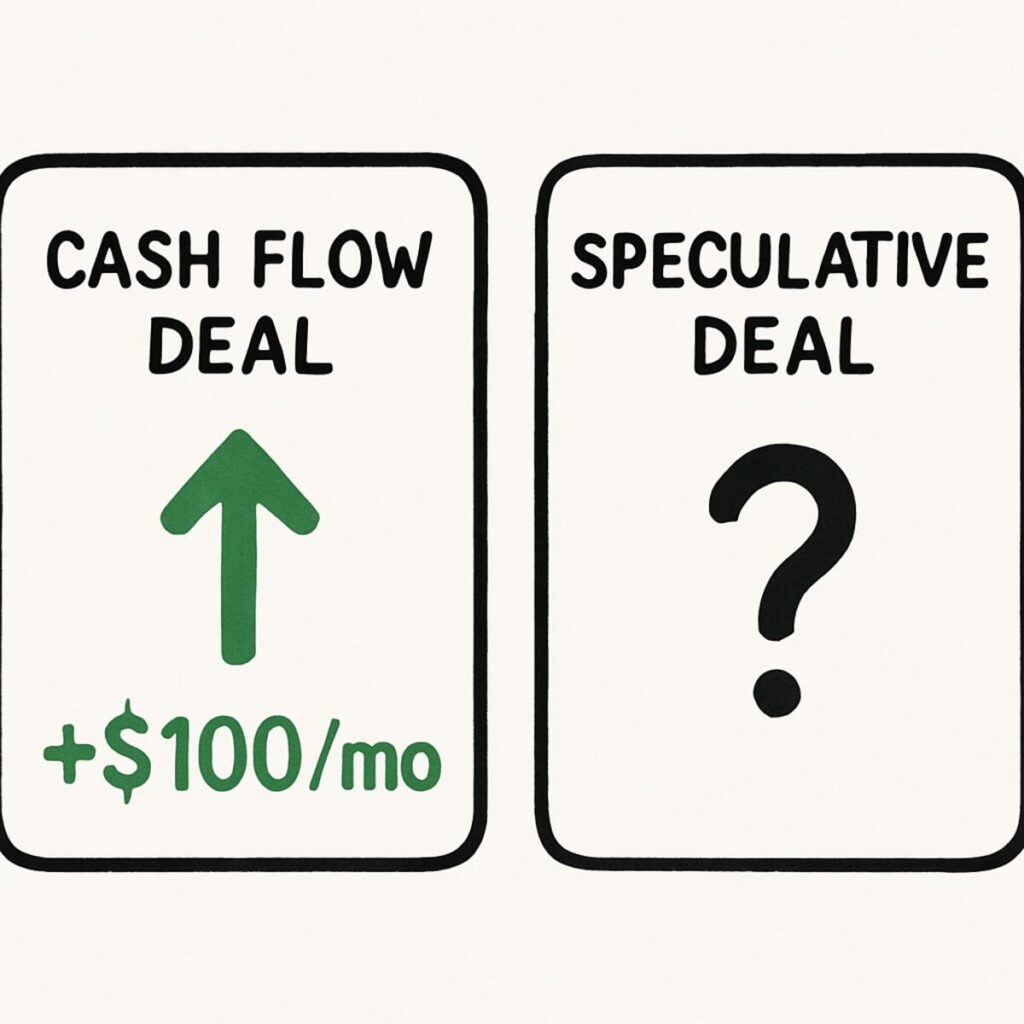
The most powerful deals are those that create positive cash flow. This is a simple but crucial concept: it’s the money an asset puts in your pocket every turn after all its own costs are paid. For example, an Opportunity card might let you buy a rental duplex that generates $200 in monthly cash flow. Choosing this deal immediately increases your passive income by $200, bringing you one step closer to escaping the Rat Race. This is how you learn about assets and liabilities in a real, practical way.
In contrast, some cards offer a potential capital gain. This is a different strategy, closer to speculation. You might buy a stock or a plot of land that produces no monthly income, hoping its price goes up so you can sell it for a big, one-time profit later. While this can sometimes work out, it’s a gamble. A speculative deal doesn’t contribute to your monthly passive income, so it doesn’t help you achieve the game’s primary goal.
The game’s passive income simulation forces you to weigh these two options constantly. As the image below shows, a deal with steady cash flow is a dependable tool for building financial freedom, while a speculative deal is a roll of the dice. To win, focus on acquiring assets that pay you every month. Of course, your strategy can’t just be about finding good deals; you also have to be prepared for life’s unexpected surprises.
“Doodads” and Market Cards: How the Game Teaches You to Handle Life’s Surprises
While building up assets is the exciting part, the Cashflow game also mirrors a less thrilling reality: unexpected expenses. In the game, these financial curveballs come from two types of cards, “Doodads” and “Market” cards. They are designed to improve financial literacy by teaching one of the most practical lessons: being prepared for the unexpected. What the game teaches here is that your defense is just as important as your offense.
Drawing a “Doodad” card represents those moments where you spend money on something that doesn’t earn you anything back. Think of it as an impulse buy or a non-essential purchase—the card might say, “You buy a new boat!” The cost is immediately subtracted from your cash, showing you how quickly discretionary spending can drain the money you’ve saved for investments. It’s a simple but powerful simulation of how easily good financial habits can be derailed.
Market cards are a bit different; they represent bigger life events or economic shifts. You might draw a card that presents a challenge, like “New Baby Arrives—Increase Your Expenses!” or an unexpected repair bill. These events powerfully demonstrate why keeping a healthy “Cash on Hand” balance is so critical. Without this cash cushion—your emergency fund—a single bad draw can force you to sell assets or even take on expensive debt just to stay afloat.
These cards show that Cashflow 101 isn’t just about getting rich; it’s about building financial resilience. The game forces you to manage risk and plan for setbacks, not just chase opportunities. This focus on creating a stable financial foundation is a core lesson that separates it from games purely about accumulating properties and bankrupting opponents.
Cashflow vs. Monopoly: Two Games, Two Radically Different Lessons About Money
While both games involve rolling dice and buying properties, their core philosophies about money couldn’t be more opposed. Monopoly teaches you to win by accumulating everything and driving your opponents into bankruptcy. For you to win, everyone else must lose. This classic zero-sum approach makes it one of the most competitive financial education games out there. The Cashflow game, however, completely flips this idea on its head.
In Cashflow, your primary opponent isn’t the other players—it’s your own financial statement. The goal isn’t to bankrupt anyone; it’s to escape the “Rat Race” by building enough passive income to cover your monthly expenses. Because the goal is personal, the atmosphere of the game changes. Players often find themselves cheering for each other and sharing strategies. It becomes a powerful exercise in collaborative learning, where one person’s success doesn’t require another’s failure.
This difference also changes what a “good” investment looks like. In Monopoly, everyone covets Boardwalk because it has the highest potential to bankrupt an opponent. In the Cashflow game, a “boring” two-bedroom house that reliably puts an extra $100 in your pocket each month is often a far better move than a flashy, expensive asset. The game teaches you to value consistent cash flow over glamorous accumulation.
Ultimately, Monopoly teaches you how to use assets to beat other people. Cashflow teaches you how to use assets to free yourself. This profound shift in perspective highlights the game’s focus on improving your own financial situation, not dominating a competitive landscape. In fact, a huge part of improving your situation involves understanding the other side of your balance sheet—your liabilities.
The Smart Way to Use Debt: How Paying Off Liabilities Frees Up Your Future
Most of us think of debt as a hole to climb out of—the faster, the better. But the Cashflow game teaches a more strategic approach. Instead of just throwing money at whatever you owe, it shows you how to target specific liabilities to accelerate your financial progress. It’s a powerful lesson in making your money work smarter, not just harder.
Here’s how it works. Remember how liabilities take money out of your pocket each month? When you have extra cash, you have a choice: buy an asset or pay down a liability. Paying off your ‘car loan’ in the game, for instance, instantly eliminates that monthly payment. This increases your positive monthly cash flow, leaving you with more money after every single turn.
This turns debt repayment into a kind of investment. If your character has a ‘credit card’ liability costing $100 per month, paying it off gives you an extra $100 forever in game time. This simple shift is a core lesson; sometimes the best return on your money comes from eliminating a monthly drain, not just from buying a new asset. It’s about understanding your personal financial statement and where your money really goes.
By strategically zapping the liabilities that drain your cash the most, you supercharge your ability to save and invest. Every dollar you free up from a monthly payment is another dollar you can put toward an income-generating asset. This is the ultimate getting out of the rat race strategy, and it’s the key that unlocks the door to the game’s final stage: The Fast Track.
What Happens on “The Fast Track”? A Glimpse of Life After the 9-to-5
Once your investments generate more income than your job pays, you’ve done it. You’ve successfully used the getting out of the rat race strategy to achieve financial freedom within the game. At this point, you physically move your game piece from the small, inner loop to the large, outer loop called “The Fast Track.” This new path represents a world where you are no longer tied to a 9-to-5 job; your money is now doing all the heavy lifting for you, and your choices become much, much bigger.
On the Fast Track, the scale of the passive income simulation completely transforms. The small deals for starter homes and stocks are gone. Instead, the opportunities are for things like buying a 24-unit apartment building, investing in a new business, or taking a company public. The numbers are astronomical compared to the Rat Race, requiring huge cash outlays but offering massive returns. It’s a shift from a mindset of monthly survival to one of building generational wealth and making a major impact.
So, what’s the ultimate goal? The answer reveals how to win. It’s not just about accumulating the most money. At the start of the game, you chose a “Dream”—perhaps starting a charity, funding medical research, or simply sailing around the world. Your new mission on the Fast Track is to land on the space that allows you to buy that dream. This is the true win condition: using your financial independence to achieve your life’s purpose.
This final stage drives home the game’s core lesson: money is a tool, not the end goal. Achieving financial freedom opens the door to pursuing what truly matters to you. The Fast Track is less about a race and more about a victory lap where you get to decide what your legacy will be.
Is the Cashflow Game Actually Worth Your Time? An Honest Review
After learning about escaping the Rat Race and reaching the Fast Track, it’s fair to ask: is this game actually a good use of your time? The short answer is yes, but not because it’s a perfect simulation of real life. Think of it less as a crystal ball for investing and more as a “financial flight simulator”—a place to practice making money moves and learn from mistakes without risking a single real dollar.
The game’s greatest strength is its ability to change how you think. It’s one thing to read about assets and liabilities; it’s another to experience the “aha!” moment when buying a small rental property adds $100 to your monthly income. For many, this is what makes it one of the best financial education games available.
However, it’s crucial to understand the game’s limits. The deals are simplified, the math is perfect, and you won’t find opportunities handed to you on a card in the real world. An honest review must point out these differences:
- Pros: Changes your financial mindset, offers risk-free practice, and makes learning about money feel fun and engaging.
- Cons: Deals are often oversimplified, the game can move slowly, and it doesn’t reflect the true complexity of real-world investing.
So, is the game worth it? Absolutely, if your goal is to build financial confidence and start seeing money as a tool you can control. It won’t make you an expert overnight, but it will teach you the rules of a game many of us were never taught how to play.
How You Can Play Cashflow Classic for Free Right Now
The best part about the game is that you don’t need to buy a board game to see if you like it. The creator, Robert Kiyosaki, offers the original version, Cashflow 101, as a completely free-to-play experience on his website. This gives you a no-risk way to try your hand at escaping the Rat Race. For those looking for a free way to play Cashflow Classic, this is the official and most direct way to access the financial simulator.
When you visit the site, you’ll likely see two options: one for adults and one for children. The version for adults, Cashflow 101, is the game you want. You might also see Cashflow for Kids, which is a wonderful but much simpler tool. The rules for the kids’ version are stripped down to focus only on the most basic concepts, making it perfect for younger learners but less challenging for adults. Be sure to select the classic game to get the full experience.
Playing the online version is the perfect first step. You don’t need to create an account or enter any personal details to start; you can just jump right in. Think of it as your personal financial sandbox—a place to experiment, learn the mechanics of generating income, and make mistakes without any real-world consequences. It’s the ideal way to see how the game’s lessons start to click for yourself.
Your First Step Outside the Rat Race: From Game Board to Real Life
Before today, the “rat race” might have just been a feeling—that familiar cycle of a paycheck coming in and bills taking it right back out. After seeing the board, you now understand it as a game with rules you can learn. You’ve seen how small, smart decisions can create a path toward financial control, turning abstract concepts into a clear, playable map.
The biggest prize the Cashflow game offers is not a secret stock tip or a complex real estate formula; it’s the mindset shift you experience when you start seeing the world through the lens of assets and liabilities. The true ‘aha!’ moment is realizing that financial freedom isn’t about a bigger salary; it’s about owning things that pay you.
This is more than a game to improve financial literacy; it’s a simulator for your own life. The most effective strategy it offers doesn’t begin with investing thousands of dollars. It starts with the exact same tool the game gives you: a simple financial scorecard to see where you stand right now.
You don’t need to wait to play. Grab a piece of paper. On one side, list all your monthly income. On the other, list all your monthly expenses. That simple act of seeing your cash flow in black and white is your first move. It’s the first step on the board, and the beginning of playing a new game with your own money.
