


Navigating the complex waters of international trade has never been more challenging. With global supply chains facing unprecedented disruptions, shifting geopolitical landscapes, and increasingly stringent customs regulations, businesses are under immense pressure to ensure their goods move across borders swiftly and securely. If your company is involved in international trade, you already know that customs delays, security checks, and endless paperwork can eat into your profit margins and damage customer relationships. Learn the best info about aeo audit.
But what if you could bypass the red tape? What if customs authorities viewed your business not as a potential risk, but as a trusted partner?
This is where the Authorized Economic Operator (AEO) program comes into play. Becoming an AEO is like receiving a VIP fast-pass for global trade. However, achieving this highly coveted status requires undergoing a rigorous AEO audit. Rather than viewing this audit as an administrative burden, savvy businesses treat it as a strategic tool to optimize their entire supply chain.
In this comprehensive guide, we will explore the immense value of AEO accreditation, break down the core requirements, and provide actionable strategies to help you navigate the process. Whether you are wondering how to prepare for AEO certification or looking to optimize your current customs procedures, this guide will serve as your ultimate roadmap.
Chapter 1: Understanding the Authorized Economic Operator (AEO) Program
Before diving into the intricacies of an AEO audit, it is crucial to understand what the AEO program actually is and why it was created.
The Origins of the AEO Program
Following the global shifts in security concerns in the early 2000s, customs administrations worldwide recognized the need to secure international supply chains without hindering the flow of legitimate trade. In response, the World Customs Organization (WCO) introduced the world customs organization safe framework of Standards to Secure and Facilitate Global Trade (SAFE Framework).
The AEO program was born out of this framework. It was designed to create a standard of supply chain security that customs authorities globally could recognize and trust. By voluntarily adhering to these strict standards, businesses prove they are low-risk operators. In return, customs authorities reward them with simplified customs procedures, fewer physical inspections, and priority treatment.
What is an AEO Audit?
An aeo audit is a comprehensive evaluation conducted by customs authorities (or certified third-party auditors in some preparation phases) to determine if a company meets the strict criteria required to hold AEO status.
During an aeo audit, inspectors will meticulously review your company’s internal controls, financial health, IT security, physical security, and historical customs compliance. The goal is to ensure that your business operates with a high degree of integrity and has robust systems in place to prevent tampering, theft, or customs fraud.
While the formal audit is conducted by government customs officials, many businesses opt for a preliminary or free aeo audit offered by specialized compliance consultants. These pre-audits act as a health check, allowing organizations to identify vulnerabilities and rectify them before the official government inspectors arrive.
Chapter 2: Decoding the Types of AEO Status
Not all AEO certifications are the same. Depending on your business model, your role in the supply chain, and your strategic goals, you can apply for different tiers of AEO accreditation. Understanding the differences is vital for tailoring your preparation efforts.
AEO-C (Customs Simplifications)
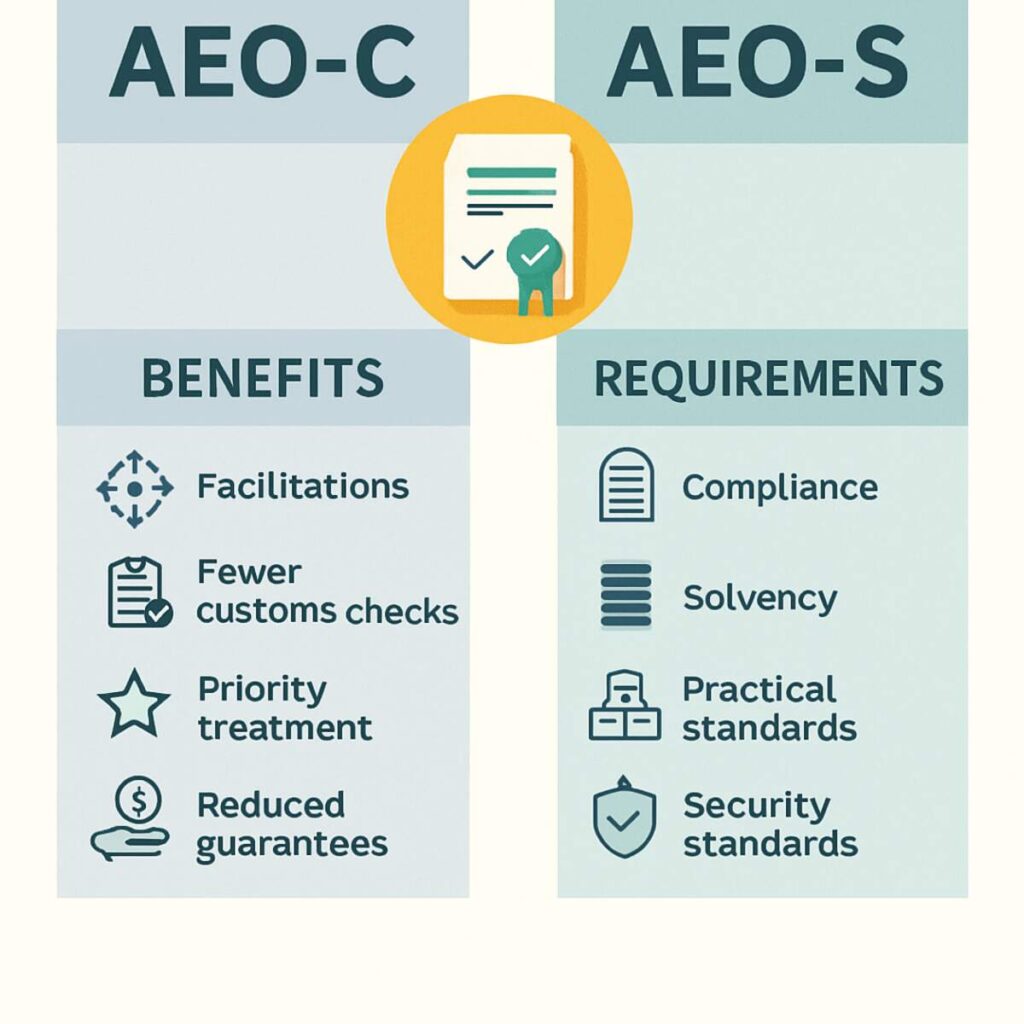
The AEO-C certificate is primarily focused on customs competence and financial health. It is designed for businesses that want to streamline their administrative customs processes.
- Target Audience: Importers, exporters, customs brokers, and manufacturers.
- Core Focus: Accurate customs declarations, excellent record-keeping, and financial solvency.
- Main Perks: Easier admittance to customs simplifications, fewer document-based controls, and priority processing during customs clearance.
AEO-S (Security and Safety)
The AEO-S certificate focuses heavily on the physical and digital security of the supply chain.
- Target Audience: Warehouse keepers, freight forwarders, carriers, and logistics providers.
- Core Focus: Facility security, employee vetting, cargo handling safety, and IT protection.
- Main Perks: Fewer physical and document-based border controls regarding security, and prior notification if selected for an inspection.
Evaluating AEO-C vs AEO-S Certification Benefits
When weighing aeo-c vs aeo-s certification benefits, it is important to look at your company’s operational bottlenecks.
If your primary pain point is the administrative burden of filing customs declarations and tying up capital in customs guarantees, AEO-C is highly beneficial. It allows for reductions in comprehensive guarantee amounts, freeing up crucial cash flow.
Conversely, if your delays happen physically at the border due to cargo inspections, AEO-S provides the greatest return on investment. Furthermore, AEO-S is the status most commonly recognized internationally by other countries.
Note: Many companies opt to apply for both simultaneously, resulting in a combined AEO-F (Full) status that grants the benefits of both the C and S categories.
Chapter 3: The Strategic Benefits of AEO Certification Audits
Undergoing an AEO audit is not merely an exercise in ticking compliance boxes; it is a transformative process. When a company aligns its operations with AEO standards, the benefits ripple across the entire organization.
1. Streamlining Customs Clearance Through Trust-Based Partnerships
At its core, the AEO program is about trust. When you pass an AEO audit, you are essentially signing a partnership agreement with customs authorities. Because you have proven that your internal controls are air-tight, customs authorities spend less time scrutinizing your shipments. Streamlining customs clearance through trust-based partnerships means your goods spend less time languishing in ports and more time moving toward your customers. This predictability is a massive competitive advantage.
2. Impact of Trade Facilitation on Operational Efficiency
The impact of trade facilitation on operational efficiency cannot be overstated. Without AEO status, companies must build buffer times into their supply chains to account for unexpected customs holds. With AEO certification, lead times become highly predictable. This predictability allows companies to embrace Just-In-Time (JIT) manufacturing and inventory management, significantly reducing warehousing and storage costs.
3. Mitigating Risks in International Trade Logistics
An AEO audit forces a company to look deep into its operational vulnerabilities. By implementing the required security protocols, you are inherently mitigating risks in international trade logistics. This includes reducing the risk of cargo theft, preventing the smuggling of illicit goods within your containers, and protecting your proprietary data from cyber-attacks. An AEO-compliant supply chain is a resilient supply chain.
4. Leveraging Mutual Recognition Agreements in Global Commerce
One of the most powerful benefits of achieving AEO-S or AEO-F status is the ability to leverage mutual recognition agreements (MRAs) in global commerce.
An MRA is an arrangement between two countries’ customs administrations where they agree to recognize each other’s AEO programs. For example, if a UK-based company holds AEO status and ships goods to the United States (which has the C-TPAT program), the US Customs and Border Protection will recognize the UK AEO status and grant that shipment the same expedited treatment they would give to a domestic C-TPAT member. MRAs effectively multiply your AEO benefits globally, streamlining the export process in foreign markets.
5. Enhanced Reputation and Marketability
In today’s business environment, security and compliance are major selling points. Many large multinational corporations now require their suppliers, freight forwarders, and logistics partners to hold AEO certification as a prerequisite for doing business. Passing an AEO audit elevates your brand’s reputation, proving to stakeholders, investors, and clients that you adhere to the highest global standards.
Chapter 4: Core Pillars: Requirements for Authorized Economic Operator Status
To reap the benefits outlined above, a company must prove it meets stringent criteria during the audit. The requirements for authorized economic operator status are generally grouped into several core pillars. Whether you are applying in Europe, Asia, or the Americas, these foundational elements remain largely consistent.
Pillar 1: Demonstrated History of Customs Compliance
You cannot become a trusted partner if you have a history of breaking the rules. Customs authorities will review your company’s compliance record over the past 3 to 5 years (depending on the jurisdiction).
- What auditors look for: A lack of serious or repeated infringements of customs legislation and taxation rules. They will check if your business, your directors, and your customs managers have any criminal records related to economic activity.
- How to pass: Ensure all customs declarations are accurate. If errors occurred in the past, you must demonstrate that you voluntarily disclosed them to customs and have since implemented corrective measures to prevent recurrence.
Pillar 2: Resolving Gaps in Customs Internal Controls
Your company must have a robust logistical system with excellent record-keeping. The auditor needs to see an unbroken audit trail connecting your commercial records, transport documents, and customs declarations.
- What auditors look for: Procedures that distinguish between Union (or domestic) and non-Union (or international) goods. They will evaluate your internal control systems to ensure unauthorized access to your software and shipping records is impossible.
- How to pass: Focus on resolving gaps in customs internal controls by implementing automated ERP (Enterprise Resource Planning) systems, conducting regular internal audits, and ensuring strict version control on all customs-related documentation.
Pillar 3: Financial Solvency Criteria for Customs Simplified Procedures
Customs authorities need assurance that your business is financially stable enough to meet its obligations, including paying import duties and taxes.
- What auditors look for: They will evaluate the financial solvency criteria for customs simplified procedures. This means your company must not be subject to bankruptcy proceedings. They will review your net assets and liquidity ratios, and ensure that you have fulfilled your obligations to pay customs duties and taxes for the last three years.
- How to pass: Provide clean, audited financial statements. If your company operates on tight margins or has low liquidity, be prepared to provide a letter of backing from a parent company or a bank guarantee.
Pillar 4: Practical Standards of Competence or Professional Qualifications
This requirement applies primarily to AEO-C status. Your company must demonstrate that the people handling your customs affairs actually know what they are doing.
- What auditors look for: A practical standard of competence. This can be proven either by a minimum of three years of practical experience in customs matters or by holding recognized professional qualifications in customs processes.
- How to pass: Ensure your customs manager undergoes regular training. Maintain a clear organizational chart detailing who is responsible for customs matters and keep their training certificates on file.
Pillar 5: Physical Security Measures for Trade Accreditation
For AEO-S applicants, security is the paramount concern. Your facilities must be fortified against unauthorized entry, and your goods must be protected from tampering.
- What auditors look for: Strict physical security measures for trade accreditation. This includes evaluating your perimeter fences, lighting, CCTV coverage, alarm systems, and physical access controls (like badge readers or biometric scanners).
- How to pass: Ensure all external doors and windows are secured. Implement a strict visitor management policy where all guests are logged, badged, and escorted. Cargo loading and unloading areas must be monitored and restricted to authorized personnel only.
Chapter 5: How to Prepare for AEO Certification
The thought of an extensive government audit can be daunting. However, knowing how to prepare for aeo certification strategically can turn a stressful event into a smooth, rewarding project. Preparation is typically broken down into three distinct phases.
Phase 1: The Feasibility Study and Gap Analysis
Before you even download an application form, you need to know where your company currently stands. Form a cross-functional project team including representatives from Logistics, Finance, IT, HR, and Facility Management.
Conduct an internal gap analysis against the AEO criteria. This is the perfect time to utilize a free aeo audit tool available online or to bring in a specialized AEO consultant for a pre-audit. These tools will help you identify red flags—such as outdated security cameras, gaps in your IT firewall, or a lack of formalized HR vetting procedures.
Phase 2: Documenting Standard Operating Procedures (SOPs)
One of the most common reasons companies fail an AEO audit is not a lack of compliance, but a lack of documented compliance. You might have the best security practices in the world, but if they aren’t written down in an SOP, the auditor cannot verify them.
You need to document everything:
- How do you select and vet your logistics partners?
- What is the procedure if a seal on a shipping container is found broken?
- How does HR conduct background checks on new warehouse employees?
- What are the steps for terminating IT access when an employee leaves the company?
Writing clear, concise, and accessible SOPs is the backbone of AEO preparation.
Phase 3: Training and Implementation
Once your new procedures are documented, you must train your staff. The customs auditor will not just sit in a boardroom reading your manuals; they will walk the floor of your warehouse. They will stop forklift drivers and ask them what they would do if they spotted an unauthorized person in the loading bay. If the employee doesn’t know the answer, you risk failing the audit.
Conduct mock audits and emergency drills to ensure that supply chain security standards and best practices are ingrained in your company culture, not just sitting in a binder on a manager’s desk.
Chapter 6: The Authorized Economic Operator Application Process Steps
Once your preparation is complete, it is time to formally engage with customs. The authorized economic operator application process steps generally follow a standard trajectory, though specific portals and timelines vary by country.
Step 1: Submission of the Application and Self-Assessment Questionnaire
The process begins with submitting an application form along with a highly detailed Self-Assessment Questionnaire (SAQ). The SAQ is a comprehensive document that forces you to answer detailed questions about every facet of your business, from your corporate structure to your IT back-ups. It is highly recommended to have a customs expert review your SAQ before submission, as inconsistencies here will trigger deep scrutiny later.
Step 2: Customs Acceptance and Initial Review
Once submitted, the customs authority will check your application for completeness. They will do a preliminary background check on your company’s customs history and financial solvency. If everything is in order, they will formally accept the application, which usually triggers a legal deadline for them to complete the audit (often 120 days in the EU).
Step 3: The On-Site AEO Audit
This is the main event. Customs auditors will visit your premises (and potentially multiple sites if you have several warehouses). They will verify that the answers provided in your SAQ match reality.
During the site visit, auditors will:
- Review commercial and transport records.
- Interview key personnel (Customs Managers, HR Managers, IT Directors).
- Tour the facility to inspect physical security.
- Observe cargo loading and unloading processes.
Step 4: Audit Reporting and Remediation (If Necessary)
After the visit, the auditors will compile a report. If they find minor non-conformities, they will not immediately reject your application. Instead, they will issue an action plan, giving you a set period (usually 30 to 60 days) to rectify the issues. For example, if they noticed a blind spot in your CCTV coverage, you will be given time to install a new camera and submit proof.
Step 5: Issuance of the AEO Certificate
Once the auditors are satisfied that all criteria are met, your AEO certificate will be issued. Your company’s details will be entered into the relevant customs databases, and you will immediately begin receiving the benefits, such as reduced guarantee requirements and lower risk scores for physical inspections.
Chapter 7: Essential Supply Chain Security Standards and Best Practices
For those pursuing AEO-S, security is the most heavily weighted component of the audit. To guarantee success, you must implement world-class supply chain security standards and best practices. Here are the critical areas to focus on:
1. Business Partner Security
You are only as secure as the weakest link in your supply chain. AEO standards require you to have a clear process for selecting and evaluating your business partners (suppliers, transport companies, customs agents).
- Best Practice: Require your partners to sign security declarations. Give preferential treatment to partners who are already AEO certified or hold a recognized equivalent (like C-TPAT or TAPA). Conduct annual audits of your key logistics providers to ensure they maintain security standards.
2. Cargo Security
Goods must be protected against unauthorized addition, removal, or exchange.
- Best Practice: Use high-security seals (compliant with ISO 17712) on all international shipping containers. Implement a strict “seven-point inspection” process for all empty containers before they are stuffed, checking the undercarriage, doors, walls, and roof for hidden compartments.
3. Personnel Security
Insider threats are a significant risk in global logistics.
- Best Practice: Conduct thorough background checks on all prospective employees, particularly those working in sensitive areas like the warehouse or IT. Ensure temporary staff and contractors are subject to the same vetting processes. Implement a clear policy for retrieving ID badges, keys, and revoking IT access on the exact day an employee leaves the company.
4. IT Security
With the digitization of customs declarations, protecting your data is just as important as protecting physical cargo.
- Best Practice: Ensure robust firewalls, multi-factor authentication (MFA), and complex password policies are in place. Have a documented disaster recovery and business continuity plan. Back up your customs and commercial data daily and store the backups in an off-site, secure location.
Chapter 8: Maintaining Compliance with International Customs Regulations
One of the biggest misconceptions about AEO status is that once you get the certificate, the work is done. In reality, AEO is not a finite project; it is an ongoing commitment to excellence. Maintaining compliance with international customs regulations requires continuous effort.
Customs authorities retain the right to conduct unannounced spot checks or to schedule formal reassessments (usually every three years) to ensure you continue to adhere to the standards.
Strategies for Ongoing Compliance:
- Assign an AEO Champion: Designate a specific individual or team to maintain AEO standards. They should track regulatory changes and update internal SOPs accordingly.
- Conduct Annual Internal Audits: Treat your AEO status as you would your financial accounts. Perform an annual internal audit to catch SOP drift. Are employees still logging visitors correctly? Are container seals still being logged in the registry?
- Proactive Notification to Customs: AEO requires transparency. If your company changes its legal entity, moves to a new warehouse, changes its IT software, or discovers a significant customs error, you must proactively notify customs authorities. Waiting for them to find out during a re-assessment can result in the suspension or revocation of your AEO status.
Chapter 9: Actionable Toolkit: Customs Compliance Self-Assessment Checklist
To help you kickstart your preparation journey, we have compiled a high-level customs compliance self-assessment checklist. Use this to identify immediate gaps in your operations.
Section A: Company Information and Compliance History
- [ ] Have we had any significant customs penalties or infringements in the last 3 years?
- [ ] Is our company structure, including board members and key shareholders, fully documented and transparent?
- [ ] Do we have a designated customs manager with proven experience or qualifications?
Section B: Record Keeping and Internal Controls
- [ ] Does our ERP/accounting system provide a full audit trail from purchase order to customs declaration to final payment?
- [ ] Are our customs records archived securely and easily retrievable for at least 3 to 5 years (as required by local law)?
- [ ] Do we have a documented procedure for detecting and reporting irregularities (e.g., stock discrepancies, suspected fraud)?
Section C: Financial Solvency
- [ ] Are our financial statements audited annually by an independent third party?
- [ ] Can we prove we have had no bankruptcy proceedings in the last 3 years?
- [ ] Do we have a consistent record of paying customs duties and VAT on time?
Section D: Physical Security (For AEO-S)
- [ ] Is the perimeter of our facility secured with fencing and adequate lighting?
- [ ] Is access to the facility controlled via ID badges, a manned reception, or electronic gates?
- [ ] Are there high-definition CCTV cameras monitoring all entry points and cargo loading bays?
- [ ] Do we have a strict visitor management policy including logging, badging, and escorting?
Section E: Cargo and Personnel Security (For AEO-S)
- [ ] Do we use ISO-compliant high-security seals for all international shipments?
- [ ] Do we conduct 7-point inspections on empty containers before loading?
- [ ] Are background checks performed on all new hires, especially those handling cargo or IT systems?
- [ ] Do we have a documented procedure for terminating facility and IT access for exiting employees?
If you answered “No” to any of these questions, those areas should become your immediate priorities as you prepare for your official AEO audit.
Conclusion: The AEO Audit as a Catalyst for Growth
In an era where supply chain resilience can make or break a company, the aeo certification is no longer just a “nice-to-have” badge; it is a critical business asset. While the preparation for an aeo audit requires a significant investment of time, resources, and dedication, the return on investment is unparalleled.
By achieving this trusted status, you are doing more than just pleasing customs officials. You are tightening your internal controls, securing your physical premises, protecting your valuable data, and optimizing your logistics flows. You are dramatically reducing border delays, freeing up working capital, and positioning your company as a reliable, highly secure partner in the global market.
Whether you are just starting to research the requirements for authorized economic operator status or are actively working through the authorized economic operator application process steps, remember that the ultimate goal is not just a certificate. The true benefit lies in the operational excellence your company will achieve along the way. Embrace the audit, elevate your standards, and unlock a new level of seamless global trade.
